
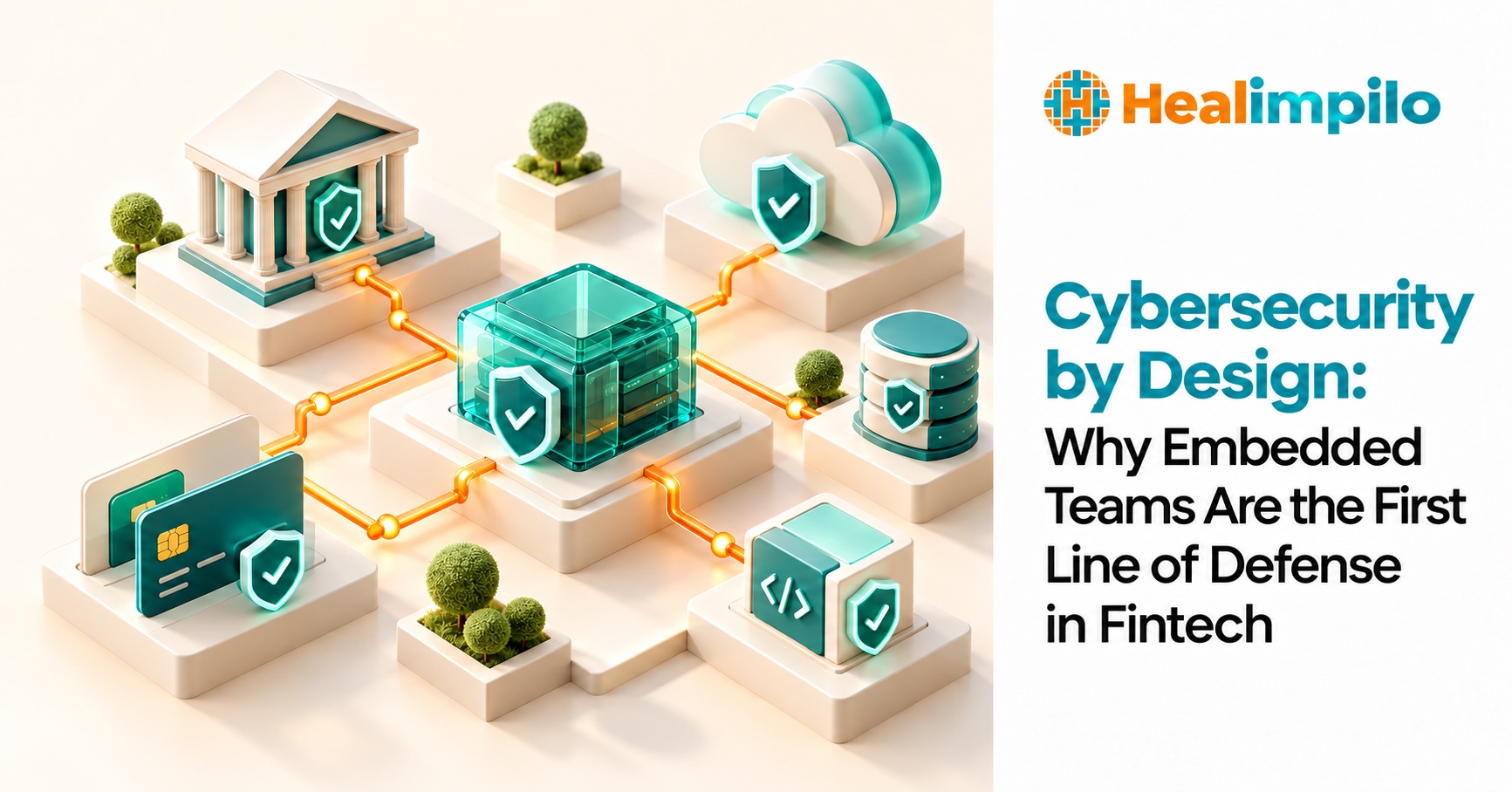
Cybersecurity by design brings security judgment into fintech product teams while they build. As services, API endpoints, and cloud accounts multiply, a central review queue can become a bottleneck. Therefore, growing teams need security expertise close to everyday engineering decisions.
Consider a fintech that grows from twenty services to hundreds of interconnected components. Its original review process may struggle with that larger attack surface. However, embedding security capability can help teams address risks before they become expensive design changes.
A useful operating model has three complementary layers. First, the central CISO function owns strategy, policy, governance, and engagement with the board and regulators. It sets expectations and provides oversight across the organization.
Next, a platform security team builds shared tools, detection rules, and automated response playbooks. These capabilities give product teams a consistent foundation. As a result, each team can reuse established controls instead of inventing its own.
Finally, embedded security engineers work directly with product teams. They bring threat modeling, code review, and security design into daily delivery. Their context helps them identify risks while the architecture can still change.
The OWASP security champions program describes a related way to build security capability within development teams. Champions can support design reviews and threat modeling. However, they need training, time, and access to specialist support.
A team shipping frequent releases cannot rely solely on a lengthy review before launch. By then, risky assumptions may already shape several services. Fixing them can require changes to data flows, permissions, and partner integrations.
Instead, security controls should inform requirements and architecture from the start. The joint secure-by-design guidance from CISA and international partners calls for ownership of customer security outcomes. It also describes threat modeling as a way to inform secure defaults.
Early review does not remove the need for testing or independent assurance. Rather, it gives those activities a stronger design to assess. Teams can then use scanning and expert judgment together, with clear ownership of the findings.
The approach becomes practical through a repeatable set of engineering habits. Each habit should have an owner and evidence that it works.
Threat modeling during requirements and architecture. First, map sensitive data, trust boundaries, and likely abuse cases. Review the model when a feature changes those assumptions. Later testing can then target the risks the team identified.
Least privilege as the default. Give each service and credential only the access it needs. Also, revisit permissions as responsibilities change. Short-lived credentials and clear access ownership can reduce the impact of mistakes.
Risk-based vulnerability prioritization. Consider reachability, exposure, exploitability, and business impact alongside scanner severity. For example, a flaw on a public payment endpoint may need urgent attention. However, an apparently unreachable path still needs review when dependencies or configurations change.
API security in the platform foundation. Build authentication, authorization, input validation, and monitoring into shared components. In addition, define certificate handling and token lifecycle rules early. Where appropriate, mobile device attestation can provide another signal alongside server-side controls.
These habits connect implementation to architectural judgment. For a related discussion, read our article on reviewing code for architecture and quality risks. The same principle applies: passing automated checks does not settle every design question.
The advantage is context as well as speed. An embedded engineer understands the product’s data flows, business logic, and operational constraints. Consequently, security discussions can address real failure modes instead of relying only on generic checklists.
For example, a payment workflow may need careful authorization across merchants, accounts, and support roles. A reviewer who knows those relationships can challenge assumptions before release. Meanwhile, the central security team can provide specialist guidance and independent oversight.
For fintechs addressing PCI DSS requirements, SOC 2 assurance, and privacy obligations, this creates a clearer evidence trail. Applicable requirements still depend on scope and circumstances. Therefore, teams should document decisions, control owners, and verification results as they work.
Cybersecurity by design does not guarantee that a breach will never happen. It makes prevention, detection, and recovery part of engineering responsibility. Ultimately, embedded capability works best alongside strong shared platforms and accountable central leadership.
Healimpilo is a technology advisory firm working with companies across healthcare, fintech, life sciences, and SaaS on engineering strategy, talent, and delivery.