
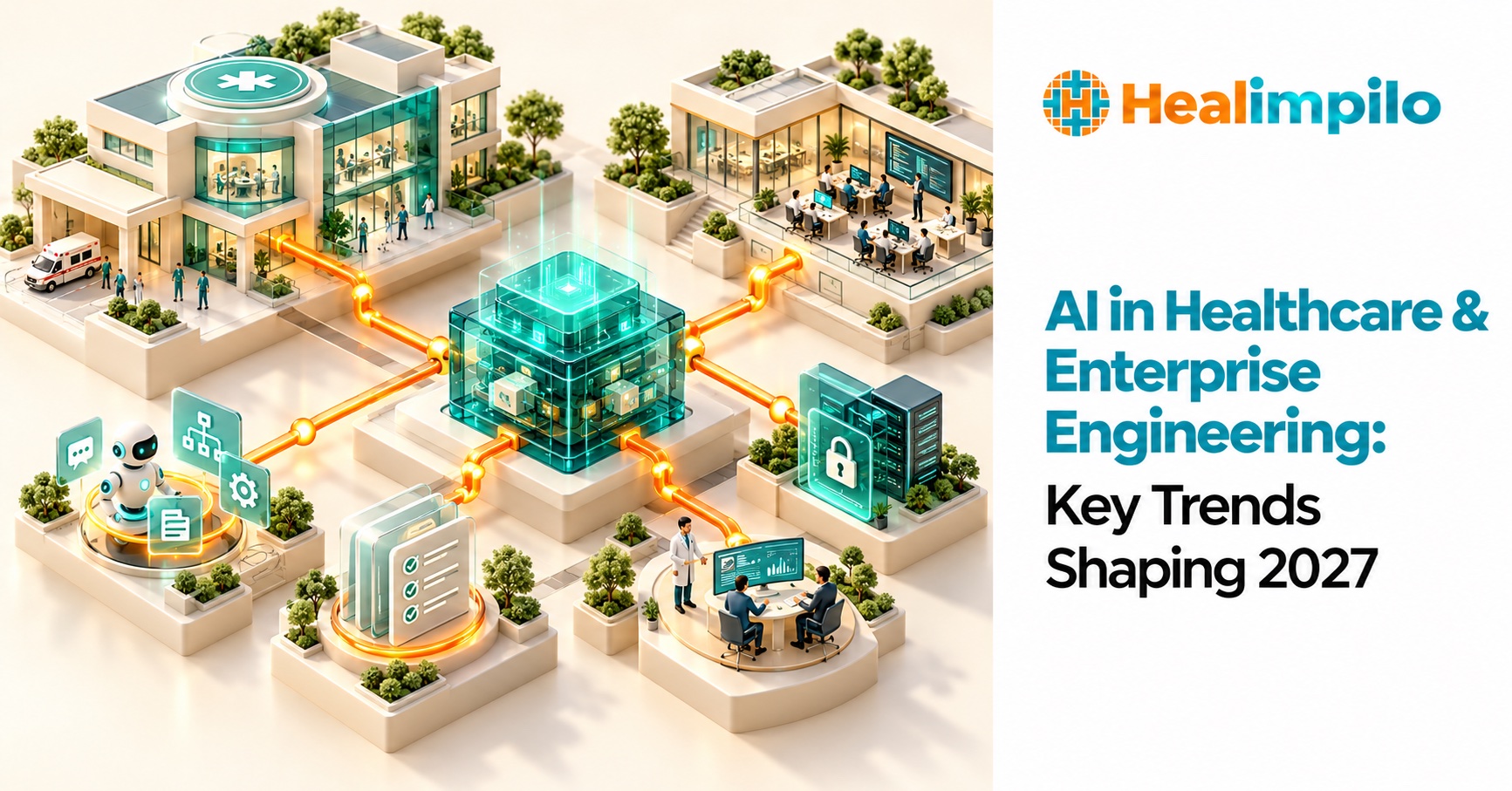
AI trends 2027 point toward a shift from experimentation to disciplined delivery. Healthcare and enterprise engineering teams need more than promising pilots. They need systems that produce measurable value, fit existing workflows, and support clear oversight.
As organizations plan for 2027, five priorities deserve attention: production readiness, trust, security, talent, and platform choices. Together, these trends offer a practical way to assess where an AI program needs work.
Healthcare shows how wide the gap can be. A 2026 report from The Health Management Academy and Microsoft surveyed executives from 30 leading health systems. It found that 43 percent were piloting or testing agentic AI. However, only 3 percent reported deployment in live workflows.
These findings describe the surveyed health systems, rather than every healthcare organization. Nevertheless, they illustrate the work between a promising demonstration and reliable daily use.
Meanwhile, Gartner predicts that more than 40 percent of agentic AI projects will be canceled by the end of 2027. Its forecast cites rising costs, unclear business value, and inadequate risk controls. This is a projection, not a measured cancellation rate.
Therefore, teams should prove value in a narrow workflow before expanding. Start with a defined outcome, named owners, and a review window. Then measure results alongside operating costs, failure rates, and the effort needed for human oversight.
Retrieval-augmented generation can ground answers in relevant sources. However, grounding alone does not guarantee that an answer is accurate. Complex questions and incomplete evidence still need careful evaluation.
The NIST Generative AI Profile identifies confabulation among the risks organizations should manage. It provides actions for addressing risks across the AI lifecycle. Therefore, trust requires an ongoing engineering process.
For example, teams can record retrieved sources, tool actions, model versions, and review decisions. They should also test representative failure cases before and after deployment. Confidence scores need validation against real outcomes before teams use them to guide decisions.
As a result, trust infrastructure belongs in the delivery plan from the start. Audit logs, evaluation sets, escalation paths, and rollback procedures need clear owners. These controls help teams investigate failures and improve the system.
Fast release cycles make late security reviews difficult. A design flaw may already span several services by the time reviewers find it. Instead, engineers should consider threats, access boundaries, and sensitive data during requirements and architecture.
Embedded security expertise can support that work inside product teams. Meanwhile, central specialists provide shared tooling, policy, and independent oversight. The two roles reinforce each other.
Our guide to cybersecurity by design and embedded teams explains this approach in fintech. Similar planning questions arise in healthcare: who can access data, what actions require approval, and how will teams detect misuse?
Consequently, compliance evidence should grow alongside the implementation. Record control owners, design decisions, and verification results during the sprint. However, early security work still needs later testing and review.
Among AI trends 2027, the talent question extends beyond tool fluency. Teams need people who can evaluate outputs, explain tradeoffs, and recognize when automation creates unacceptable risk. Technical depth and domain knowledge work together.
For example, an engineer working in healthcare needs to understand the workflow and its data obligations. A financial services architect must also understand the controls relevant to the system. Neither role succeeds through prompting skill alone.
Compensation varies by employer, location, seniority, and the mix of salary and equity. Therefore, leaders should avoid treating a broad salary forecast as a hiring plan. Instead, identify the skills the organization needs and develop them through supervised delivery.
In addition, internal training can connect AI expertise with knowledge of existing systems. Pair engineers with security, compliance, and operational specialists. That collaboration helps teams build judgment around real decisions.
A collection of point tools can create duplicated integrations and inconsistent controls. Consequently, engineering leaders should assess the whole platform, including retrieval, orchestration, evaluation, governance, and observability.
A unified platform may reduce that overhead. However, it can also increase dependence on one vendor. Teams should evaluate data portability, exit options, pricing changes, and the ability to replace individual components.
Next, separate core intellectual property from capabilities that a partner can provide. Build where differentiation matters, and assess external services against clear requirements. This makes consolidation an architectural decision rather than a purchasing shortcut.
The common thread is disciplined execution. Start with a useful workflow, build trust controls early, and give people clear responsibility for outcomes. Then expand only when the evidence supports it.
For healthcare and enterprise SaaS teams, these priorities connect adoption to dependable delivery. Ultimately, the aim is to build AI systems that teams can explain, operate, and improve over time.
Healimpilo is a technology advisory firm working with companies across healthcare, fintech, life sciences, and SaaS on engineering strategy, talent, and delivery.